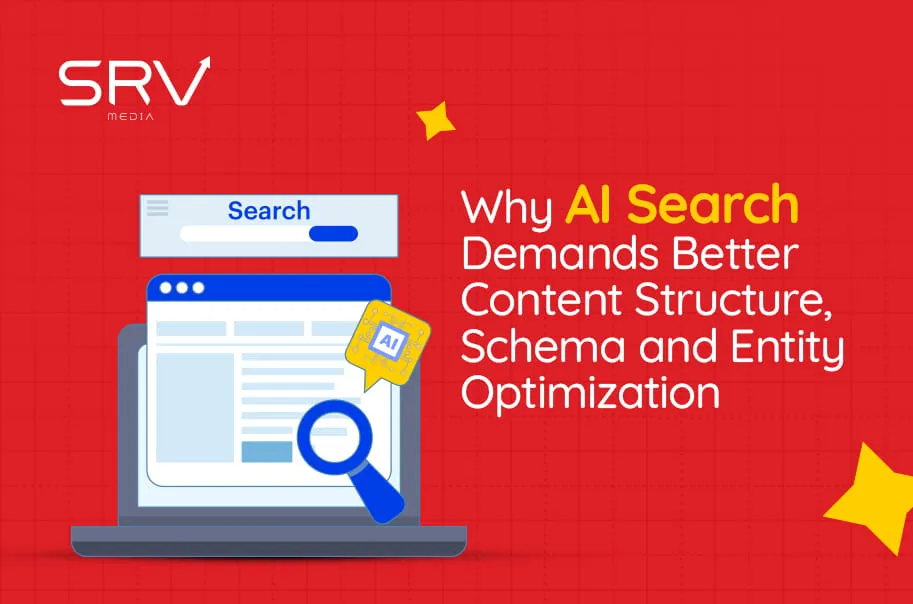
Why AI Search Demands Better Content Structure, Schema and Entity Optimization
Key Takeaways
- AI-powered search platforms now prefer clear, well-structured, and context-rich content.
- Proper schema markup helps AI platforms understand your pages more accurately.
- Semantic SEO matters more than repetitive keyword usage.
- Strong Entity SEO improves brand recognition and topic relevance in AI search.
- Technical SEO still plays a major role in AI-driven discoverability.
- Consistent content across platforms strengthens trust and authority signals.
- Businesses that adapt early improve their visibility in AI-generated search experiences.
Search engines no longer work the same way they did a few years ago. Users now interact with AI-powered platforms that generate direct answers instead of showing only traditional search results. Platforms like Google, OpenAI, Gemini, and Perplexity now summarize content, compare brands, and answer detailed questions instantly.
This shift is reshaping how brands build and maintain search visibility online.
Traditional SEO focused heavily on rankings, backlinks, and keyword optimization. AI-driven search platforms now look at how clearly your content is organized, how relevant it feels to the topic, and how easy it is for AI platforms to understand before using it in answers.
That is why modern AI search visibility strategies now focus on well-structured content, proper schema markup, and strong entity signals that help AI platforms understand and trust your brand.
More users now rely on AI-generated responses and conversational search instead of browsing multiple webpages. Brands that adapt early improve their chances of appearing across AI-powered search experiences.
How AI Search Engines Process Content
Traditional search engines mainly matched keywords with indexed pages. AI-powered systems now process content differently.
Large Language Models and generative search systems evaluate:
- Context
- Topic relationships
- User intent
- Semantic relevance
- Entity associations
- Structured data
- Authority signals
AI systems do not simply scan for repeated keywords. They identify whether your content provides structured and trustworthy answers.
This evolution is reshaping modern AI search optimization practices.
AI search engines extract information from content that is:
- Clearly structured
- Contextually relevant
- Technically organized
- Easy to interpret
- Supported by semantic relationships
Content that lacks structure often becomes difficult for AI systems to process accurately.
Why Content Structure Matters in AI Search
AI systems prioritize content that follows logical formatting patterns.
Well-structured content improves machine readability and helps AI models extract precise information quickly. Search engines and AI assistants process content more efficiently when information appears in clear and organized formats.
Strong content structure for AI search typically includes:
- Clear H1, H2, and H3 hierarchy
- Short informational paragraphs
- Question-based headings
- Definition-focused sections
- Bullet points for extraction
- FAQ sections
- Topic clustering
Example of AI-friendly formatting:
Weak Structure
Long sections of content without clear headings or topic separation.
Strong Structure
- Clear heading structure
- Direct answers in the first paragraph
- Supporting context below
- Related concepts grouped logically
This approach helps AI platforms understand and use your content more accurately across:
- AI Overviews
- Featured snippets
- Voice search
- Conversational AI responses
- Zero-click search experiences
Clear formatting also makes your content easier for AI platforms to understand and present accurately.
The Technical Role of Schema Markup
Schema markup has become one of the most important technical components of AI-driven discoverability.
Schema markup gives search engines and AI platforms clear information about your content, brand, and page context.
Strong schema markup for AI search helps AI platforms understand your content better because it clearly explains what each page and topic represents.
Important schema types include:
- FAQ Schema
- Article Schema
- Organization Schema
- Breadcrumb Schema
- HowTo Schema
- Review Schema
Schema implementation supports:
- Quicker understanding of content meaning and context
- Improved indexing efficiency
- Better content categorization
- Enhanced AI extraction accuracy
For example, FAQ schema helps AI systems identify question-answer patterns directly. Organization schema strengthens brand recognition and authority signals.
Structured data also improves eligibility for:
- Rich results
- AI-generated summaries
- Knowledge panels
- Conversational search responses
Search engines now depend more on structured data because AI platforms need clear context to understand and present information accurately.
Why Semantic Search Reduces Keyword Dependency
Traditional SEO focused heavily on repeating exact keywords. AI-powered search now gives more importance to content that explains topics naturally and clearly.
Users now search conversationally.
Example:
Traditional search query:
“best project management software”
AI-driven conversational query:
“What project management platform works best for remote software teams?”
AI systems analyze intent and contextual meaning behind the query.
That is why modern SEO for AI answers focuses more on detailed topic coverage and meaningful content relevance.
Your content should naturally connect related ideas instead of overusing the same keywords repeatedly.
Strong semantic optimization includes:
- Related topic integration
- Natural contextual relationships
- Intent-focused explanations
- Supporting subtopics
- Conversational formatting
This structure helps AI platforms understand your content better and increases the chances of your information appearing in AI-generated answers.
Entity Optimization and AI Relevance
Entity recognition has become a core component of AI search visibility.
Search engines now rely on entities to understand relationships between concepts, industries, brands, and services.
Entities include:
- Brands
- Technologies
- Services
- Industries
- Products
- Locations
- People
Strong Entity SEO helps AI platforms associate your brand with the right expertise and topics.
For example, content focused on AI-driven search visibility should naturally reference related entities such as:
- Knowledge Graphs
- Semantic Search
- Conversational AI
- Structured Data
- Search Intent
- Large Language Models
Entity relationships improve topic clarity and help AI platforms trust your content more.
Google’s Knowledge Graph uses entity mapping to understand content more accurately.
This process improves GEO AI search visibility because generative platforms rely heavily on entity connections when creating answers.
Topical Authority Improves AI Trust
AI platforms prefer websites that show clear and consistent expertise.
Single-page optimization no longer creates strong authority signals. AI-powered search systems now evaluate how comprehensively a website covers a topic.
Websites build topical authority through:
- Pillar pages
- Cluster content
- Supporting educational blogs
- FAQs
- Industry commentary
- Research-driven insights
This structure strengthens AI search content strategy because AI systems identify websites that consistently publish expert-level content.
Topical authority also supports E-E-A-T principles:
- Experience
- Expertise
- Authoritativeness
- Trustworthiness
Websites that consistently publish educational and technically reliable content gain stronger AI visibility over time.
Technical SEO Still Supports AI Discoverability
AI-powered search still relies on strong technical website performance.
Important technical SEO factors include:
- Crawlable architecture
- Mobile responsiveness
- Fast loading speed
- HTTPS security
- Internal linking
- XML sitemaps
- Canonical optimization
Technical improvements help search engines and AI platforms process your content more effectively.
Strong Structured data SEO optimization improves how AI systems process content relationships across websites.
Technical SEO now acts as the foundation that supports semantic search visibility and AI discoverability.
AI Search Visibility Requires Multi-Platform Authority
AI visibility no longer depends only on Google rankings.
Generative search systems evaluate signals from multiple platforms including:
- ChatGPT
- Google AI Overviews
- Gemini
- Perplexity
- YouTube
Consistent information across platforms helps build trust and authority.
Brands that maintain technically structured content across platforms become easier for AI systems to reference repeatedly.
The Future of AI Search Optimization
AI-powered search is moving toward more conversational and context-focused user experiences.
Future AI visibility will increasingly depend on:
- Semantic structure
- Entity clarity
- Schema implementation
- Topical authority
- Technical SEO
- Conversational formatting
- Machine-readable content architecture
Businesses that continue relying only on traditional SEO practices risk losing visibility inside AI-generated answers.
Modern search optimization now requires clear content structure, relevant information, and strong technical SEO.
At SRV Media, you get future-focused digital marketing solutions designed for evolving AI-powered search. Our team combines technical SEO expertise, structured content strategy, AI-focused optimization, and performance-driven execution to help your business improve long-term search visibility and authority across modern AI search platforms.